
Blog/Product Tutorials··3 min
What Helix actually connects
Relationships reconstructed from merge history: the map an organization can trust.
- Helix graph model
- GitHub history
- code ownership
- software relationships
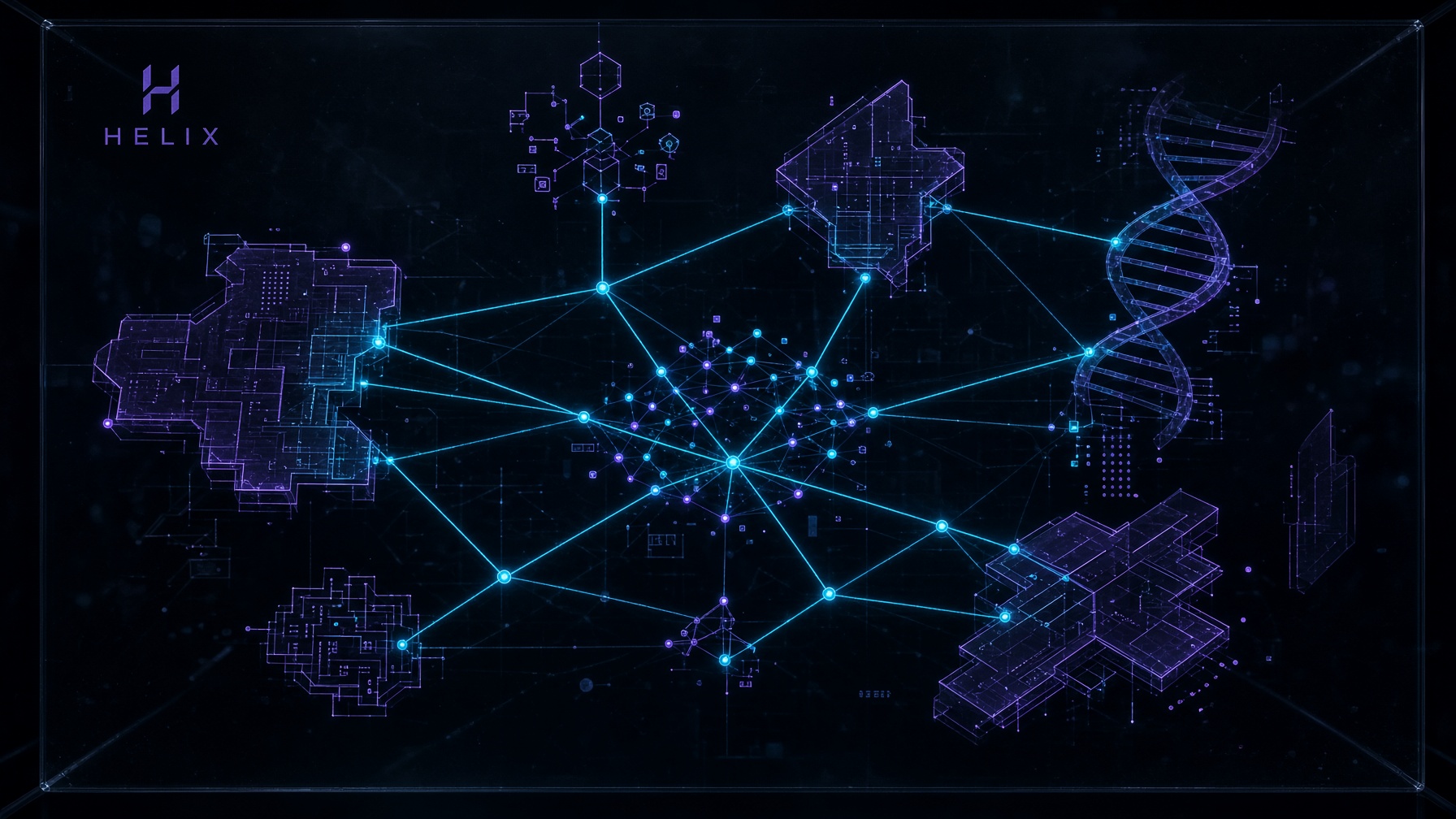
A codebase is not a tree of files. It is a set of things that happened: people shipped pull requests, folders absorbed the blast radius, two files refused to move independently, a comment said “fixes #40.”
Helix records those events as edges. Nothing is inferred without a label.
The original six
- BELONGS_TO: a pull request lives in a repository.
- AUTHORED: a person wrote it.
- REVIEWED: a person signed it.
- MODIFIED: the change touched a file.
- LEARNED / WATCHES / ENCODED: agent loops writing DNA back onto the graph.
Those are enough to answer “who knows checkout.ts?” They are not enough for a two-hundred-person org.
The missing layer
Organizations talk in folders. “Who owns src/?” is a staffing question. “What moves with payments?” is a risk question. “Did #41 mention #40?” is a history question.
Helix reconstructs:
- directory nodes from path prefixes
- CONTAINS: repository → folder → file
- COUPLED: files that share two or more merged PRs
- MENTIONS:
#Nin a title or body - OWNS: majority author on a file, in this window
- TOUCHED: the person who keeps working in a folder
Pulse lists architecture. Ask Helix answers “Who owns src?” The API returns the same nodes an IDE can query.
graph.addEdge({ from: "pr:acme/storefront#41", to: "pr:acme/storefront#40", type: "MENTIONS" });
graph.addEdge({ from: "file:checkout.ts", to: "file:payments.ts", type: "COUPLED" });
Why this is the org map
A wiki is what you hoped was true last year. CODEOWNERS is what you assigned. The graph is what the merge history will still admit on Monday morning.
That is how a new hire finds the five folders that matter, how a staff engineer sees coupling before they “just tweak the copy,” and how a VP sees bus factor without a slide.
Software should explain itself. Relationships are how. Open Helix and click an edge until it becomes a sentence.